Showing posts with label American Bible Society. Show all posts
Showing posts with label American Bible Society. Show all posts
Tuesday, July 9, 2024


Thursday, June 27, 2024
Monday, November 21, 2016
Scripture: It's not just for Protestants, says Papal Nuncio
 |
| Credit: Ryk Neethling via Flickr (CC BY 2.0). |
Philadelphia, Pa., Nov 8, 2016 / 06:53 am (CNA/EWTN News).-
While reading the Bible may be associated with Protestantism in the minds of
some, love of Scripture is at the core of the Catholic Church, said the
apostolic nuncio to the United States.
“The love and veneration of the Word of God is an expression
of the heart of the Catholic Church which is increasingly promoting a ‘new
hearing’ of God’s Word through the new evangelization of our cultures,”
Archbishop Christophe Pierre said Oct. 26. “This new hearing is a recovering of
the centrality of the divine Word in our Christian life and in our dialogue
with those who do not share our Catholic faith.”
The archbishop addressed a gathering of the American Bible
Society in Philadelphia,
where the 200-year-old organization is now based. The non-denominational organization
is dedicated to translating, publishing and distributing editions of the Bible.
Among those present for the nuncio’s remarks were Archbishop
of Philadelphia Charles J. Chaput and Dr. Roy Peterson, the president and CEO
of the American Bible Society.
Archbishop Pierre said Sacred Scripture is “at the very
heart of the Christian life.” He noted the ancient Catholic tradition to teach
and pray Sacred Scripture. The Church Fathers venerated God’s word and prayed
it through the practice of Lectio Divina.
“The nature of the Sacred Scriptures calls for an audience
of faith who opens the sacred texts to discover the presence of the living God
speaking to the soul of the believer,” he said.
This has helped drive the Church’s concerns for proper
renditions and translations of the sacred texts, the nuncio recounted.
Different Latin variants of Sacred Scripture in the early
Church put at risk the shared story of the Church. In the year 382, responding
to concerns about the variant texts of the Bible, Pope Damasus I commissioned St. Jerome to revise the
texts for a new version “that would embrace more faithfully the truth of the
revelation,” the archbishop noted.
“His dedication to Scripture motivated Jerome to further
study the Hebrew and the Semitic tradition involved in the sacred texts. Thus
Jerome grew in a deeper and more profound union with the mystery of God though
the knowledge of Scriptures,” Archbishop Pierre said.
Over time, the Latin language itself became an obstacle to
spreading the Biblical message, as Latin’s use became restricted to a small
group of educated people. The Latin Vulgate maintained its dominance as the
official version of Scripture in the Roman Catholic Church, while other
translations were regarded with suspicion for misleading the faithful.
“The love and devotion of the Catholic Church was, and
continues to be, the true motivation behind the faithful custody and zealous
preservation of the truth that God wanted put into sacred writings for the sake
of salvation,” the archbishop said.
He reflected on Martin Luther’s “painful separation” from
the Catholic Church. Though he praised the Protestant leader’s dedication to
accessible Scripture, he noted that Luther modified the biblical canon from 46
books to 39 and modified the Letter of the Romans’ text to add his concept of
“through faith alone.”
The response to the Protestant movement by the Council of
Trent established that all Sacred Scripture “must be read according to the
spirit in which they were written.”
“This implies that Scripture must go hand-in-hand with the
holy Tradition preserved in the ecclesiastic experience of the faith of the
apostles,” Archbishop Pierre said.
The development of different languages continued to separate
people from a close reading of the Latin Scriptures and, the archbishop said,
separated them from “having a personal encounter with the risen Lord manifested
in the Bible.”
“The separation produced by the Protestant Reform left a
painful wound in the mystical body of Christ and as a consequence of this, the
belief that a personal reading of the Bible is a typical Protestant practice
grew in the common Catholic mindset,” he said. “The reality manifested in our
Roman Catholic Tradition, however, indicates that this common assumption is far
from the truth.”
Archbishop Pierre recounted developments since the pontificate
of Pope Leo XIII. In the mid-20th century, Pope Pius XII opened the way for
translation of Scripture to help Christians return to the sources of faith,
while the Second Vatican Council opened the way to dialogue with Protestant
Christians in its main document on Scripture, “Dei Verbum.”
“During the decades after ‘Dei Verbum,’ the magisterium of
the Roman Catholic Church has insisted on the continued study, research, and
education of Holy Scripture by the faithful people of God, establishing stronger
bonds of ecumenical dialogue and relationships of unity with our brothers and
sisters of different denominations,” he said.
The archbishop cited the work of the Pontifical Biblical
Commission, the Biblical studies in Rome’s pontifical universities, and the
biblical institutes throughout the Catholic world that train pastors and the
laity to bring biblical truth “to those who are hungry for the nourishment of
God’s Word.”
The nuncio praised the American Bible Society as “a
providential instrument that exemplifies the ecumenical bonds built upon the
treasure of the Scriptures.” He welcomed its collaboration with Catholic
ministries, saying its propagation of the Word of God is “a vivid expression of
the love of God that unifies us with the purpose of inspiring hunger and thirst
for the Scriptures.”
The Bible society supported the October 2008 Synod of
Bishops and has created a polyglot Bible. It has distributed Bibles to
Spanish-language Catholic communities and has supported Catholic pastoral
activities like the World Youth Day events in Poland
and Brazil.
The society also collaborated with the 2015 World Meeting of Families in Philadelphia.
Saturday, May 14, 2016
American Bible Society marks 200th birthday
Religion News Service: American Bible Society marks 200th birthday
America, The National Catholic Review: A Bicentennial to Bibles
Wednesday, January 28, 2015

Tuesday, October 7, 2014
The Blessing of Long Life
On Sunday, September 28th, Pope Francis celebrated at St. Peter’s Square the first international day of The Blessing of Long Life dedicated to the elderly and grandparents. At the request of the Holy Father, American Bible Society donated 100,000 copies of the Gospel of St. Mark published in large print and in Italian. The Scripture was distributed to all those in attendance at the Square.
In the following photos are Dr. Roy Peterson, President of ABS, and his wife Rita, greeting the Holy Father and personally giving him a copy of the Gospel of St. Mark.


In the following photos are Dr. Roy Peterson, President of ABS, and his wife Rita, greeting the Holy Father and personally giving him a copy of the Gospel of St. Mark.
Friday, April 18, 2014
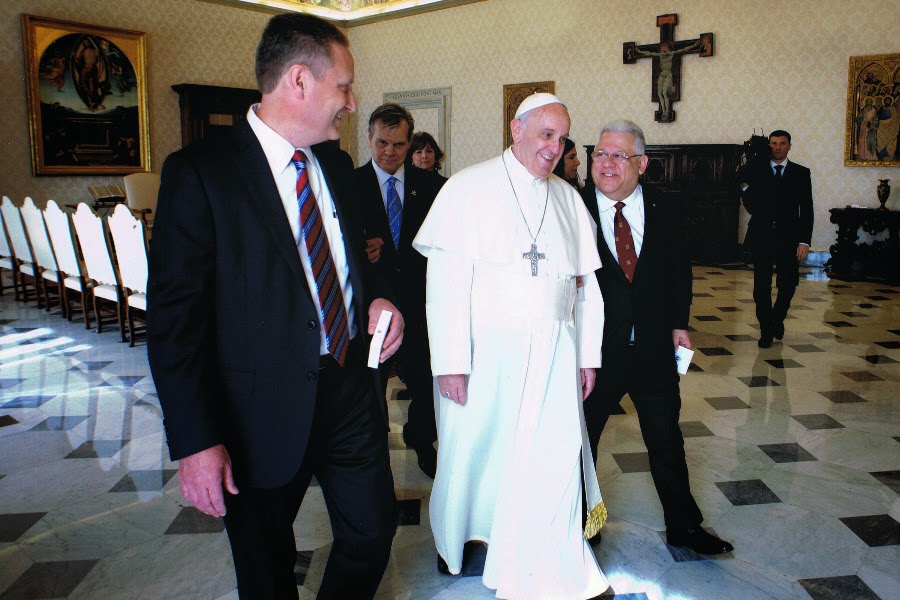
Pope Francis welcomes representatives of Museum of the Bible and American Bible Society
On March 31st, His Holiness Pope Francis granted an audience to the representatives of Museum of the Bible and executives of American Bible Society. On this occasion, Pope Francis welcomed our delegation at the Apostolic Palace in the Vatican.
Our visit was due to the inauguration of Verbum Domini II Bible Exhibit on display at the Vatican until June 22nd.
 |


Saturday, April 12, 2014


Wednesday, November 6, 2013
American Protestant-based group making inroads with Catholics
November 6, 2013
(Romereports.com)
Founded nearly 200 years ago, the American Bible Society has always played a big part in spreading the Gospel within the United States.
The non-profit organization was founded by Protestant leaders in the early times of the American nation. But in the past few decades they've begun reaching out to Catholics.
“The mission of the American Bible Society is to spread the Word of God, to make available to all people. And certainly, an important segment of Christianity is the Catholic Church. And so this inter-confessional organization called American Bible Society is opening the door to the Catholic Church and serving the Catholic communities.”
- Mario J. Paredes, American Bible Society
This outreach has reached the top levels of Catholicism. The organization's president addressed the Synod of Bishops in 2012. And their latest effort is the book Pray With the Bible, Meditate With the Word. It was published in collaboration with the LEV, the Vatican's publishing house.
The book is described as a manual on Lectio Divina, studying Christianity's Holy Book. It features a four step process: knowing the text, understanding the words, meditating on their message and putting them into action.
“The end goal of the Lectio Divina is to bring people back to the Bible, and to bring people back to praying with the Bible. It's to bring people to get to know the God of the Bible, and a relationship that can become a personal relationship between myself and the God of the Bible.”
- Mario J. Paredes, American Bible Society
The book is available in three languages: English, Italian and Spanish. It's available at specialty bookstores. Over time, the American Bible Society has expanded its services beyond the United States. Keeping in line with their mission, this book is another resource they provide for Catholics worldwide to better understand the Gospel.
Wednesday, October 29, 2008
Monday, October 6, 2008
“Thy word is a lamp to my feet and a light to my path.” (Psalm 119.105)
 In a letter dated February 8, 2008, the Reverend Dennis C. Dickerson, Ph.D., Chairman of the Board of Trustees of the American Bible Society confirmed ―via His Excellency Nikola Eterović, Archbishop of Sisak and General Secretary of the Bishops’ Synod— the offer previously made to His Holiness Pope Benedict XVI, to prepare and publish a special edition of the Polyglot Bible – Biblia Polyglotta.
The Context
This special edition of the multilingual Bible is intended as a gift from the American Bible Society to the Pope and to all the participants in the XII General Assembly of the Synod of Catholic Bishops, which will take place on October 5 to 26, 2008 in Vatican City. The Synod’s theme is The Word of God in the Life and Mission of the Church. As agreed upon by the American Bible Society and the Vatican, this Polyglot Bible will feature the Old Testament in five languages: Hebrew/Aramaic, Greek, Latin, English, and Spanish; and the New Testament in four languages: Greek, Latin, English, and Spanish.
The Text

The Text
In order to accomplish this illustrious undertaking, it was necessary for the American Bible Society to acquire the publishing rights, for the various Bible versions in the languages mentioned, from the following publishing houses:
- Biblia Hebraica Stuttgartensia, Edited by Karl Elliger and Wilhelm Rudolph / 1977 and 1997 Deutsche Bibelgesellschaft, Stuttgart.
- The Septuagint, Edited by Alfred Rahlfs / 2006 Deutsche Bibelgesellschaft, Stuttgart.
- The Catholic Edition of the Revised Standard Version of the Bible, 1965, 1966 National Council of the Churches of Christ in the United States of America.
- La Biblia de Jerusalén / 1998 / Editorial Desclée De Brouwer, S.A.
- La Nova Vulgata / 1998 – Libreria Editrice Vaticana.
- The Greek New Testament / 1993 Deutsche Bibelgesellschaft, Stuttgart.
This edition of the Bible is being published by Grafica da Biblia, the printing arm of the Bible Society of Brazil. It is one of the largest Bible printing plants in the world, which currently stands at eight million units annually. Since 1995, 75.4 million Bibles and Testaments. Grafica da Biblia was built with a significant investment of the American Bible Society in 1995.
The Polyglot Bible, commemorating the Bishops’ Synod, was conceived—not as an edition for mass distribution— but as an edition with texts that could be used in liturgical assemblies, and that would have academic and exegetical merit. It will be a 3,200-page deluxe, leather-bound edition of the Bible, embellished with gold and silver titles, and dedicated to Pope Benedict XVI. The final design and production of this Polyglot Bible will be approved and endorsed by the American Bible Society and the Editrice Vaticana (the publishing house of the Vatican). It will also be an edition which Pope Benedict XVI may present as a gift to heads of state and other dignitaries who visit the Vatican.
The American Bible Society
The Polyglot Bible Project complements the mission of the American Bible Society whose purpose is to make the Bible available in the most diverse parts of the world and to the greatest number of people possible. This is done in various languages and formats so that all people may experience its life-changing message.
Founded 192 years ago, the American Bible Society is the oldest and most prestigious, non-denominational organization in the United States. It is not a church, nor is it affiliated with any denomination. However, because of the Protestant origins of our country, it is understandable that through the years, the American Bible Society has been perceived as an organization which has, to a large extent, served mostly non-Catholic churches.
The American Bible Society does not engage in doctrinal discussions, and thus is free to carry out its biblical mandate ecumenically, as it seeks to share God’s Word to all believers in Christ.
Evangelization: a common task, an ecumenical commitment
According to Monsignor Eterović, while the publication of the Polyglot Bible is designed to help us “rediscover the riches of God’s Word manifested in the person of Jesus Christ—the Eternal Word Incarnate—and its perennial importance in the life of the church, in the life of the ecclesiastic communities, in the life of society in general, and in the life of the believer,” it has now become an ecumenical edition, since its texts (all having the imprimatur and the nihil obstat of the Catholic Church) originate —as is the case with the English text—from the Protestant Council of Churches. Therefore, the symbolic value and contribution that this initiative of the American Bible Society represents for ecumenism and the work of all believers in Christ: namely, to spread the Gospel throughout the world, are enormous.
The Polyglot Bible allows us to transcend our historical foundation and reach beyond our traditions and differences both in the doctrinal and liturgical realms, as well as our diverse religious expressions. It also undergirds the common bond in ecumenism between Christians and Pope Benedict XVI’s Pontificate: the centrality that the Word of God will have in our personal, ecclesial, and social histories.
As Christians, we rejoice in the production of this biblical initiative which contributes, in a significant way, to the fulfillment of our Lord’s desire: “That all . . . may be one.”
(Production details of the Polyglot Bible: http://groups.google.com/group/mr-marios-reflections/web/biblia-polyglotta?hl=en)
Subscribe to:
Posts (Atom)