Friday, April 18, 2014

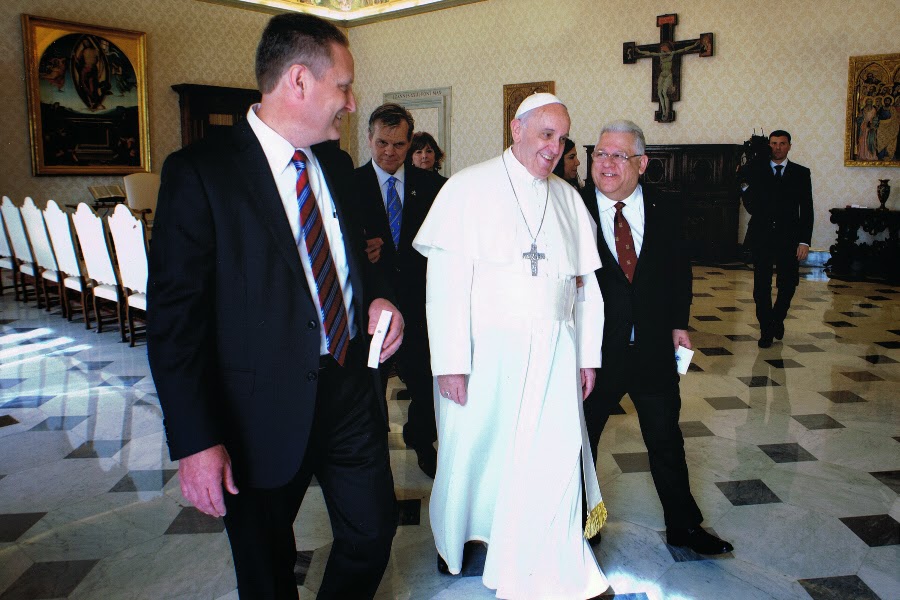
Pope Francis welcomes representatives of Museum of the Bible and American Bible Society

On March 31st, His Holiness Pope Francis granted an audience to the representatives of Museum of the Bible and executives of American Bible Society. On this occasion, Pope Francis welcomed our delegation at the Apostolic Palace in the Vatican.

Our visit was due to the inauguration of Verbum Domini II Bible Exhibit on display at the Vatican until June 22nd.


Saturday, April 12, 2014

New York Catholic Bible Summit 2014

Click here for more information.

Click here for more information.

Thursday, March 13, 2014

A Year with Francis


We have reached the first anniversary of the Pontificate of Francis. The context in which he was elected as Pope was marked by an enormous crisis of credibility in the world of the Catholic Church due, in large part, to the sexual scandals of members of the clergy that had become public, the forced resignation, including his age and physical conditions, and multiple circumstances within the Church of Benedict XVI, and the correct historical and numerical possibility that the Catholic majority of Latin Americans might have their first Pope.

From the outset, everything was new and refreshing in the election of Jorge Mario Bergoglio as Pope: the geographical location and the religious order from which he comes, his humble origin, the name chosen for his pontificate but, above all, his style, his personal manner with each word, each gesture, his way of being and acting. A new and refreshing style that immediately, silently, almost imperceptibly, yet powerfully, began to reveal itself in the options that he chose through his respective denials: an apartment instead of the palatial rooms and offices, a Renault automobile rather than luxury vehicles, worn shoes instead of brand-name footwear, his request for the people’s blessing instead of offering his blessing, etc. Options, procedures, gestures, novel style, especially in the midst of a society where power means privilege, possessions, waste, luxury, comfort, ostentation and appearance.

The intimate and simple word, the warm and welcome gesture, the smiling face, the human and compassionate expressions to the weakest and most needy are other elements that –-like the One from Nazareth or Assisi—characterize the ministry of Francis. Moreover, he is a Pope with a keen sense of humor. Humor that, together with his prayer and that of everyone for his Petrine ministry, is the best “bumper” in the midst of the difficult task of guiding the rudder of Peter’s ship, sometimes through lukewarm mornings or through threatening storms and tempests, but always with confidence in the Lord of the Church and of history.

We are able to say that Francis, in such a short time, has honored the name chosen for his pontificate, that of the poor man of Assisi, but, above all, he has honored the Gospel of Jesus Christ, to which he has dedicated his entire life. His ministry has been an authentic prophecy through the symbolic pedagogy of the testimony of his personal life.

Without a doubt, Francis has become a sign for today’s world, for our historical juncture and for all humanity. A sign of humanity for believers as well as for unbelievers, for Catholics and non-Catholics, for peoples and nations from the most diverse corners of the Earth and the most diverse cultures. Francis welcomes all, impacts all, and calls everyone’s attention through his manner of being and of living out the Church in today’s world.

His style can be summarized in a call, through his very style, to live out a Christian humanism already practiced, proven and evidenced in other times. A Christian humanism that, forgotten in today’s society, seems novel: the humanism of Jesus of Nazareth, elementary and basic, the Christian humanism of the early Christians and, later, of the poor soul of Assisi: the Brother Francis and of so many men and women that have incorporated and lived out in their life the gospel of the humble carpenter and fisherman of Nazareth. Everything is new, yet old at the same time in Francis, because he reminds us of the need to return to the basic fount and proper norm of our Christian life: the way of being and acting of Jesus of Nazareth.

Abundant, from every angle, has been the pontificate exercised by Francis in just a year: renewal of the Roman Curia, renewal of the Vatican Bank, the Advisory Council of eight cardinals for the renewal of the grand subjects of the life of the Church, the convocation of the Synod of the Family, the creation of a commission for the defense of the rights of children and, in the evangelistic and prophetic task, he has begun to place emphasis on the subjects that, in light of the gospel itself, need to be highlighted: on compassion and mercy, on humility and transparency instead of an obsession with legal and sexual subjects that are boring, that scare away and threaten believers.

Ad multos annos! May Francis have many more years to bless us! We join in prayers of thanksgiving for this fresh breeze that bubbled up in all corners of the Church and the world, and that God be pleased, amid gestures and symbols, amid exhortations and documents, to enable Francis, to not only take new positions, execute new decisions that impact in depth fundamental matters that the whole world wants to see dealt with and reconsidered in the bosom of the Catholic Church.

Following Francis and his personal seal on the ministry of Peter, the Church will never be the same. May God and Mary continue to accompany and bless and, through him, that we all be blessed.

Thursday, March 6, 2014

Verbum Domini II—God’s Word Goes Out to the Nations


On several occasions Jesus of Nazareth, the Teacher, sent his friends and disciples to carry to others the Message of the Kingdom. Sometimes on foot, sent out in pairs, from the rooftops, using all sorts of media. And in those gatherings they reminded others of the deeds and miracles they had witnessed. Such as on the occasion in which the multitude was hungry, where Jesus multiplied the fish and bread. And then he told them to gather up the left-over food. This would serve them well later, as well as to remember the miracle. Everything, even that which appeared to be insignificant, was important.

Years went by. They continued to remember, but these were later generations. The living memory was written down. Those documents were preserved, those pieces of cloth, parchment, bits of ceramic which on one occasion was found stamped with the memory of Yahve’s presence, Jesus, of the Chosen People. Many of those scripts were passed down from generation to generation. Some outlived the Roman invasions, the Temple’s destruction, the debacle of a village. Yet, although they were simple pieces, with no apparent value, for the believers they contained fragments of the living Word of the Lord. And they needed to care for them like great treasure.

Centuries have now passed. But those remains, those ceramic bits, those manuscripts have been preserved. And a family of believers in the Lord Jesus, in a God who is our Father, have dedicated their energies for years to gather those lost texts, those objects that, at one time, were used in the community to make known, to praise, and to learn about the Lord.

The Green family, who for years have dedicated themselves to gather those fragments, like the apostles who gathered the left-overs of the multiplied bread, those texts, those ceramic bits and writings, they wanted everyone to see. Those objects will be a part of a Museum, the Museum of the Bible, so that others can appreciate and study them, and be available to serve all. There will be room in this institution for biblical objects proceeding from diverse traditions of faith based on the Bible. From the respected and age-old tradition of Judaism to the diverse groups of the Christian faith such as the Reformed tradition, as well as Catholic and Orthodox.

While that Museum opens its doors there will be an exposition of some of the backgrounds which, in the future, will be incorporated in permanent, as well as temporary, expositions in the Museum.

This exposition will take place in Vatican City, near Peter’s tomb, who was one of the twelve followers of Jesus. Between April 1 and June 22 we will have the opportunity to contemplate these treasures of the Green Collection together with other artefacts on loan, the property of cultural and ecclesiastic institutions such as the Vatican Library and Museum. Among the hundreds of objects to be exhibited we underscore ten, considered the TOP TEN:
  1. Three fragments of the Dead Sea scrolls, the oldest known texts of the Hebrew Scriptures. 
  2. A double page of the “Codex Vaticanus”, one of the four uncial codices, that is, the oldest complete manuscripts of the Greek Bible, from around the years 325 to 350 A.D. This is a loan from the Vatican Library, in Vatican City. 
  3. Five pages of the Bodner Codex of the Psalms, which contains the nearly complete Book of Psalms in Greek. Written on papyrus and dated from the Third and Fourth Centuries A.D. 
  4. Pages of the Rescriptus Climaci Codex, a manuscript in palimpsest, which contains the text of the Bible in Greek from the Eighth Century and texts of the Sixth Century in Christian-Palestinian Aramaic, a language similar to the Aramaic that Jesus spoke. 
  5. A copy of the complete Bible of Tours, the oldest known copy of this Bible edited and published by Alcuino of York in the Ninth Century in the Abbey of San Martin in Tours, France. A work on loan, which is the property of the Library of the Abbey of Saint Gall in Switzerland. 
  6. The “Bath Old English Gospels”, a copy of the only complete translation of the Gospels in ancient English, done in the Ninth Century and, for the first time in history, is presented in an exhibition outside of Britain. On loan from the Parker Library of Corpus Christi College, which is part of the University of Cambridge. 
  7. A fragment never before presented of the first commentaries in Hebrew on the Pentateuch prepared by Rabi Sa´adia Gaon and dated in the Eleventh Century, discovered in Geniza of the Sinagogue of Ben Ezra in El Cairo, Egypt. 
  8. The “Book of Hours and Psalter” of Elizabeth of Bohun, countess of Northampton, edited in the Fourteenth Century and one of the most extensively decorated manuscripts that exist in its class. 
  9. A sample of the first edition of the King James Bible - the great “HE” Biblia of 1611- the most influential translation of the Bible ever produced in the English language. 
  10. One of the three Rolls of the Torah from the Jewish community of Kaifeng, in China. On loan from the Bridwell Library Special Collections, of the Perkins Theological Seminary, annex of the Southern Metodist University.

Wednesday, March 5, 2014

“All of it was very good”


The history of Judeo-Christian salvation presented in the Bible opens in the book of Genesis in the Old Testament with a marvelous statement: God looked at what he had done. All of it was very good!” (Gen 1,31). However, the obvious tragedy of evil, the overwhelming evidence of suffering, pain, violence, injustice, iniquity, and death… in the world, experienced in a thousand conflicts that are individual, or in the family, social or international contexts, cause men to ask, since the beginning, about the reasons for this disorder, for the attacks against the original harmony that God gave to his creation.

The biblical and Christian interpretation perceives the experience and the cause of evil as “sins” (plural, in the Old Testament) and as “sin” hamartía (Greek, singular, in the New Testament). This latter interpretation, of greater interest to us as Christians, as men and women of the New Testament, consists in a structural posture, a fundamental option of human life that is contrary to our Creator and compassionate and merciful Father, contrary to his will, and in the final analysis, contrary to brotherly love (especially toward the weakest), as revealed by Jesus of Nazareth. We should love in the same way and in the same proportion as God loves us. Thus, if life in God is life in love, sin is life without God, that is, without love, and the terrible manifestations of evil are understood as an absence of God’s love in the life of men and women, his creatures, his children. But, on the other hand, every definitive healing of any experience of evil in the world –-from a Christian viewpoint–- comes from the love of God among men.

In this historical juncture between modernity and post-modernity, people today are searching, without an absolute truth to orient and regulate their life. Human life today is lived out in the moral relativism of half truths, of pocket truths, of a life style that is “yours to choose,” according to which nothing has value or all has equal value in the practical sense that it gives satisfaction here and now; for we live each day without a transcendent vision of history and with the sad perspective of no future. The only thing that matters today is immediate satisfaction and all is valued or justified for that purpose.

In the world of moral relativism, laxity, subjectivism, and sentiments (as opposed to reason), a theological interpretation of evil, universal and objective, has lost its place, since everything is valid today, especially if it is prohibited, as long as it produces pleasure. On the other side we find the postures and behaviors of men and women, more appropriate to modernity, that tends to judge everything as evil, as sin, rigorously, scrupulously and, in the words of Jesus himself, “strain the gnat and swallow the camel”. Lent reminds us that not everything is sinful, although sin exists: the denial of God’s will that requires us to love each other as brothers for the construction of a better society and world than that in which we live and for which all of us are responsible.

The Lord saw how bad the people on earth were and that everything they thought and planned was evil. He was very sorry that he had made them…”(Gen 6,5-6). Lent, the liturgical season with a strong call for conversion (metanoia) is, above all, an important moment to again interpret the world and human history in light of the One upon whom our life depends. Through Christ, with Him and in Him, humanity has a new opportunity and Lent needs to be seen as an appropriate time to look again at our life and that of our neighbors according to God’s desire that we discover his love, yet at the same time, unveils our denial of God’s love and the love of our brothers. A time in which we need to discover our sin: our lying, our uselessness, our deceptions and fears; in reality, our lack of faith which is a lack of confidence in God who has been loving us and calling us eternally to his home, to life in Him.

          The conversion to which the Word of God and the liturgy of the Catholic Church calls us in the season of Lent consists of an awareness of God’s love manifested in our life, in all that we are and have and, with that, the awareness of our sin as a fundamental posture contrary to the basic love of God. Lent is a season for sincere repentance, to conform our life to the life that Jesus proposes for us in his gospel and for an absolute confidence in the forgiving love of the Father.

          All this, contrary to a society that is apparently satisfied, proud, egotistical, with its scientific and technical conquests that instead of leading us to “love one another,” have left us enclosed behind walls, full of the most sophisticated weapons designed to kill, far from life in the original Paradise for which we were created.

Lent is a call to build an ethical and moral society. The “amorality” (life without moral norms) and “immorality” (life that is opposed to moral principles) of so many, traverses these days the highways of the world, opening trenches of violence, blood, death, crisis, wars, divisions, hunger, injustice, iniquity, misery, etc.

The Christian theological system enables believers in Christ to again start something fresh, begin again, trust again in a loving Father, enjoy the embrace of his eternal love. The Sacrament of Reconciliation enables us to experience that the original harmony is still possible, that broken relations with God, with others and with nature can be finally healed and that the goodness of all things that God loved on the first day of creation is also possible today.


I invite you to live intensely this Lenten season of 2014 as a precious space and time which the Catholic liturgy grants us the possibility to seek again among us the lost Paradise that God made when he “saw that all of it was very good”.

Wednesday, February 12, 2014

“A joy that no one can take away from you” (John 16,22)


On November 24, 2013, with the conclusion of the year of faith, the solemnity of Jesus Christ, King of the universe, and the first year of the pontificate of Francis, the apostolic exhortation EVANGELII GAUDIUM (The joy of the Gospel) was published in Rome, a document that can be considered as the thinking and pathway of what Pope Francis wants his pontificate to be and, therefore, his vision for the mission of the church in this significant historical and social juncture of the human journey.

From the joy that springs from the gospel, the Good News of Jesus Christ that calls human beings to live as children of God and brothers of all in the certainty of a God revealed by Jesus Christ as a compassionate and merciful Father, Pope Francis calls all the members of the church to become missionaries, (See Chapter One) those who proclaim this good and joyful news. He invites us to go into the world, to break out of our comfort to reach —with the truth of the gospel which is Jesus Christ himself— the places, circumstances and human realities so much in need today of the gospel and the “joy that no one can take away from you” (Jn 16,22). This missionary task of the church in the world must be fulfilled by the church like a mother with an open heart that understands and embraces all human beings in her bosom. A mother with the ability to understand, interpret, love, forgive, become and convert —to the light of the gospel— the realities in which people today live and express themselves.

Among the realities that Pope Francis considers as working to deter the joy of the gospel that people should experience is the economical situation that excludes from its benefits the vast majority of human beings (See Chapter Two), due to the idolatry of money, that oppresses and undermines instead of serving, that tyrannizes and enslaves instead of empowering and making effective the solidarity, liberty, abundant life and fraternity of all people. The idolatry of money that generates inequality and injustice and, as a result, the violence that blocks the experience of the joy of the gospel and which engulfs humans in an individualistic sadness that destroys the sense of vocation of human existence.

The analysis of the great realities experienced by humanity launches —according to Francis— great missionary challenges before the church and every believer today. Challenges that have to do mainly with the enculturation of the faith and, concretely, with the way the gospel should be made known (See Chapter Three).

This evangelistic task, Pope Francis reminds us, has —both intrinsically and essentially— a social dimension (See Chapter Four). Certain community repercussions are verified by what in earlier ecclesiastical discourses were called the preferential option by the poorest of the poor. A preferential option that presupposes the vision and construction of a missionary church that is poor, of the poor and for the poor, if it desires to be and remain totally faithful to its founder: our Lord Jesus Christ.

This social dimension that springs from the Good News as lived and taught by Jesus Christ is manifested and realized especially in the gift of social and religious peace. Social and religious peace that requests a renewed dialogue between faith, reason and science, and an ecumenical dialogue between the various religions.

Finally, Pope Francis reminds us of the great motivation that we have as believers, in the bosom of the Catholic Church, to renew our missionary nature and task (See Chapter Five). In this motivation we find the salvation that God offers us in Jesus Christ, loving us as his children, the activity of the Spirit of the Resurrected One in the midst of his church and the presence of Mary as mother and star of the new evangelization.

If we sought to summarize these thoughts of Francis and of what he desires with his Petrine ministry for every disciple of Christ in the church and for the world today, we would have to say that Pope Francis dreams of:
  • A church that is a sign in the world of the joy that springs from the gospel.
  • A church that moves outward —as a missionary— toward all the human realities in order to save others with the joy of the gospel.
  • A church that lives a continuing experience of renewal, that is, conversion.
  • A church that behaves like a mother with an open heart, especially among and with the poorest and those who most need to experience God’s love.
  • The love of God that fills with joyful hope that gives life to every person and all of humanity.


Wednesday, December 18, 2013

Christmas and the Sacred Family


Christmas is an annual occurrence based on a historical and saving event: the birth of our Lord Jesus Christ, which Christians commemorate liturgically using the same name. In a materialistic society like ours, Christmas has been converted into a season for buying and selling, for spending and consuming, for show-off and waste. And in this enormous consumer traffic, the message that we remember as Christians, the significance of which we celebrate on this occasion is manipulated, glossed over or lost, or even forgotten.

The significance that Christmas has for the world in general and for Christians in particular is enormous. What we are celebrating is the birth of JESUS OF NAZARETH, who is for all peoples a model of Humanity and Divinity: since Jesus is both divine and profoundly human.

When we confess Jesus as God who has become human, we are confessing at the same time the final and definitive destiny to which all humanity is called: incarnating divinity in history, and in daily living humanizing the divine life. At Christmas time, therefore, we celebrate the joyful and hopeful certainty that in the birth of Jesus, God has shown that he wants to live with us always, revealing in himself the Way, the Truth and the Life to which we have been called.

The historical fact of Christmas occurs in the context of a family. Among the many aspects that give meaning to the commemoration of the first Christmas, the value that God accorded the family in the birth of Jesus takes on special meaning among us.

We are experiencing in our times a profound human crisis in all aspects. The serious problems that are evident in this crisis reveal a more profound and definitive crisis in the very heart of human beings: a de-humanization that is contrary to all that is meant or implied in the message of Christmas. Yet, at the same time, the serious social problems that emerge from the heart of people have their origin in a profound crisis in the family.

There is an extensive list of great conflicts which today threaten the family model proposed on that first Christmas Eve and presented in the proclamation of the Catholic Church in the Western world:

  • The generational gap between parents and children in a world that is rapidly changing.
  • The breakups, divorces and rapid and easy annulments in “express” fashion.
  • Unfaithfulness in a pan-sexual society where such is proposed and stimulated.
  • The lack of commitment in a hedonistic society that delights in levity, changes of fashion, meaninglessness, easy come-and-go, throw-aways, appearances that are purely superficial.
  • The world of academia and labor that separates, alienates and disintegrates families.
  • “Machismo” and feminism.
  • The pretended scientific manipulation of God’s designs concerning creation and family life.
  • Abortion.
  • Promiscuous use of tobacco, alcohol, and drugs.
  • The senselessness of life in a society that quickly destroys the will to live, when the end of life is reduced to something merely material and historical, masking the transcendent vision of men, of the world and of history, etc….

In a world that pleads for the plurality of ideas and life style as well as respect for individual liberty and human rights, the Truth — under that pretext — should not be denied, confused or diluted in the midst of the rash of individual, small and almost always selfish pocket versions of truth. It is the Church’s responsibility, on the basis of the Good News contained in the gospel for every man and woman of good will, to proclaim every day and, especially at Christmas time, that every person has the right to be born and “to grow in grace and wisdom” in the bosom of a family constituted by a father, a mother and children: a family model in which are replicated and lived out the relationships defined as parental love, and filial and fraternal love, that we recognize and venerate in the very heart of the Holy Trinity: Father, Son and Holy Spirit.

The troubling statistics that cry out to us concerning the millions of boys and girls that seek to “grow” and “mature” in “homes” that are dysfunctional, with a single parent, or “substitute” homes, with grandparents and other relatives or in government institutions that try to “replace” inexistent families, sound an alarm that warns us of something that is occurring in our communities as well as an urgent challenge for us to give value to living out the model of Christian family suggested in the birth of our Lord Jesus Christ.

Today, as never before, there is a nostalgia for Nazareth.

  • Nostalgia for homes where parents and children live together in harmony.
  • Nostalgia for homes like the example of Nazareth: where the parents love and fulfill God’s will, loving and nourishing the the life of their children.
  • Homes in which the children fulfill God’s will, obeying their parents.
  • Homes that tend toward the construction of a world of fraternal relationships lived out first at home in family relationships.
  • Homes in which love and respect prevail over the circumstances of life that are always difficult and always changing.
  • Homes with parents that are dedicated to the care of their children, and where the children are attentive and devoted to their parents.
  • Homes that are true domestic churches, initiating the experience of the church and seedbeds of permanent evangelization.
  • Homes in which parents and children grow in their humanity, cooperating with the creative work of God through their daily tasks.
  • Families that are true homes, that is to say, where the home fires burn with love that is able to warm and illuminate a world so often cold and in darkness.

I join with you in these days in which as Christians we live with the memory of the birth of our Lord Jesus Christ. I join in the joy of the world because “to us is born a son, a child has been given to us” that bears the name “Emanuel, meaning God is with us” and I encourage you to extend into all our homes, our family groups, our communities, the great, good, sacred and eternal lessons which we can learn and apply in the life of our family, illustrated in the home of the Sacred Family of Nazareth, on this Christmas and always.